
Mazda 3 2010 Owners Manual: A Comprehensive Guide
This manual provides essential information for 2010 Mazda 3 owners, covering operation, maintenance, safety, and troubleshooting—downloadable in PDF format.
Welcome to the world of the 2010 Mazda 3! This vehicle represents Mazda’s commitment to sporty driving dynamics and stylish design. This introduction serves as your starting point for understanding the features and capabilities of your new car. Whether you’re a first-time Mazda owner or a seasoned enthusiast, this manual will guide you through everything from basic operation to advanced system details.
The 2010 Mazda 3 offers a blend of fuel efficiency and performance, making it an ideal choice for daily commutes and weekend adventures. Familiarize yourself with the information contained within this manual to maximize your driving experience and ensure the longevity of your vehicle. Remember to consult the full owner’s manual, available as a PDF download, for comprehensive details.
Understanding Your Vehicle’s Documentation
Your 2010 Mazda 3 comes with several important documents designed to help you understand and maintain your vehicle. Beyond this overview, a comprehensive Owner’s Manual, readily available as a PDF download, details all aspects of operation and maintenance. A separate Warranty Booklet outlines your vehicle’s coverage, while service procedures can sometimes be found online through enthusiast communities.
It’s crucial to familiarize yourself with these resources. The Owner’s Manual explains everything from dashboard indicators to routine maintenance schedules. Online forums, like those discussing the Mazda 3, can offer valuable insights and disassembly guides shared by other owners; Keeping these documents accessible ensures you can address any questions or concerns that may arise during ownership.

Vehicle Features & Operation
Explore the 2010 Mazda 3’s features, including keyless entry, engine start/stop, climate control, and audio systems—all detailed for optimal driving enjoyment.
Keyless Entry & Remote Operation
Your 2010 Mazda 3’s keyless entry system allows convenient access without physically using the key. The remote keyless entry functions include door locking/unlocking, trunk release, and potentially a panic alarm. To operate, ensure the key fob battery is functional; a weak battery can limit range or cause intermittent operation.
Programming additional key fobs or replacing a lost one requires a specific procedure, often involving a dealership or qualified locksmith. Familiarize yourself with the remote’s buttons and their corresponding functions for quick and efficient control. Always be mindful of your surroundings when using remote functions, especially in public areas, to ensure personal safety and vehicle security.
Starting & Stopping the Engine
To start your 2010 Mazda 3, ensure the parking brake is engaged and the transmission is in Park (P) or Neutral (N). Fully depress the clutch pedal (manual transmission) or the brake pedal (automatic transmission). Turn the ignition key to the “Start” position and release it once the engine starts. Avoid prolonged cranking, as it can damage the starter motor.
To stop the engine, bring the vehicle to a complete stop, shift the transmission into Park (P), and turn the ignition key to the “Lock” position. Remove the key to prevent accidental operation. Always allow the engine to idle briefly before shutting it off, especially after vigorous driving, to ensure proper cooling and lubrication.
Understanding the Dashboard Indicators

Your 2010 Mazda 3’s dashboard features various indicator lights and warning signals. Familiarize yourself with these to monitor vehicle health. The check engine light indicates a potential engine issue requiring diagnosis. A low fuel warning illuminates when fuel is low. The brake warning light signals a parking brake engagement or low brake fluid.
ABS and DSC lights indicate system activity or malfunctions. A battery warning light suggests a charging system problem. Temperature warnings signal overheating. Pay close attention to any illuminated warning lights and consult the owner’s manual for specific details and recommended actions. Ignoring these signals could lead to more serious issues.
Climate Control System Operation
The 2010 Mazda 3’s climate control system offers heating, ventilation, and air conditioning. Adjust temperature using the control knob, selecting desired heat or cool settings. Fan speed is controlled separately, offering multiple levels for airflow intensity. The mode selector allows choosing between defrost, floor, vent, and blend settings for optimal comfort.
The A/C button activates the air conditioning for cooling. Recirculation mode draws air from inside the cabin, useful for quickly cooling or preventing outside odors. Ensure proper ventilation for fresh air. Regularly check and maintain the cabin air filter for optimal system performance and air quality.
Audio System & Connectivity
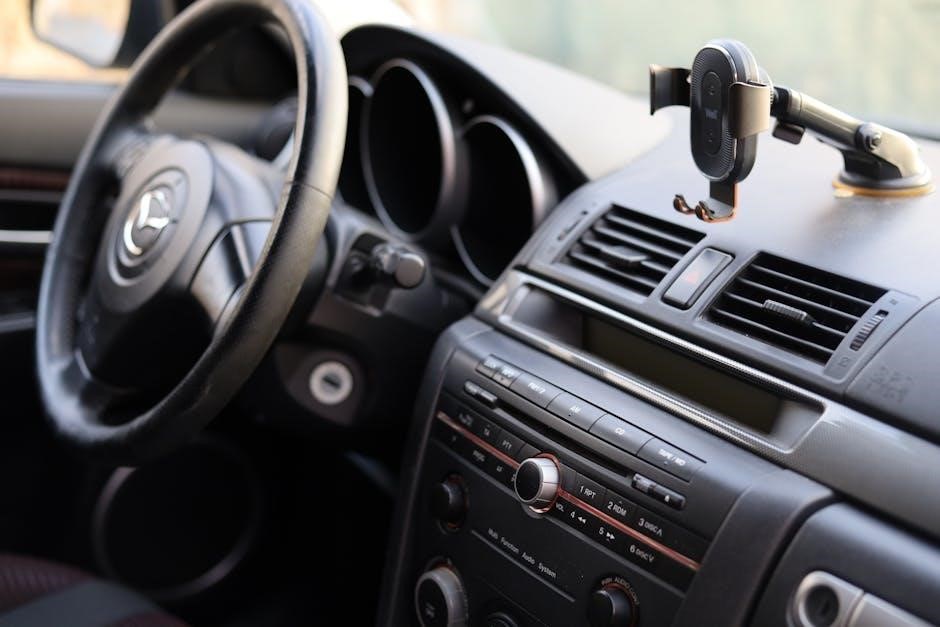
Your 2010 Mazda 3’s audio system features an AM/FM radio, CD player, and auxiliary input jack for connecting external devices. Volume and tuning are controlled via dedicated knobs and buttons. Seek/Track functions allow easy navigation through radio stations or CD tracks. The system typically includes basic tone controls for adjusting audio preferences;
For connectivity, utilize the auxiliary input to play music from smartphones or MP3 players. Some models may offer optional Bluetooth connectivity for wireless audio streaming and hands-free calling. Refer to the system’s user interface for specific operation details and available features. Ensure proper cable connections for optimal audio quality.
Maintenance & Care
Regular maintenance, including fluid checks, tire care, and scheduled servicing, is crucial for ensuring the longevity and optimal performance of your 2010 Mazda 3.
Recommended Maintenance Schedule
Maintaining your 2010 Mazda 3 according to the recommended schedule is vital for its reliability and lifespan. Generally, oil changes should occur every 5,000 to 7,500 miles using quality oil. Inspect coolant levels and condition every 30,000 miles, replacing as needed. Brake fluid should be checked annually and flushed every two years.
Tire rotations are recommended every 6,000 miles to ensure even wear, extending their life. Air filters should be inspected regularly and replaced when dirty. Spark plugs typically require replacement around 100,000 miles. Refer to your owner’s manual for a detailed schedule tailored to your driving conditions—normal or severe—as intervals may vary. Following this schedule helps prevent costly repairs and keeps your Mazda 3 running smoothly.
Checking & Replacing Fluids (Oil, Coolant, Brake Fluid)
Regularly checking and replacing fluids is crucial for your 2010 Mazda 3’s health. For oil, check the dipstick monthly and change it every 5,000-7,500 miles with the recommended grade. Coolant levels should be inspected in the reservoir when the engine is cold; flush and replace every 30,000 miles.
Brake fluid absorbs moisture, reducing effectiveness, so check it annually and flush every two years. Use only DOT 3 brake fluid. Power steering fluid levels should also be monitored. Always dispose of used fluids responsibly at a recycling center. Refer to your owner’s manual for specific fluid types and capacities to ensure proper maintenance and optimal performance.
Tire Maintenance (Pressure, Rotation, Replacement)
Maintaining proper tire care is vital for safety and longevity with your 2010 Mazda 3. Check tire pressure monthly using a reliable gauge, aiming for the PSI listed on the driver’s side doorjamb. Rotate tires every 5,000-7,500 miles to ensure even wear, promoting a longer lifespan and consistent handling.
Inspect tires for tread depth and damage regularly. Replace tires when tread reaches 2/32 of an inch, or if sidewall damage is present. Use tires of the same size and type for optimal performance. Proper tire maintenance enhances fuel efficiency and provides a safer driving experience. Consult your owner’s manual for specific tire specifications.
Battery Care & Jump Starting Procedures
Your 2010 Mazda 3’s battery requires periodic care to ensure reliable starting. Keep the battery terminals clean and free of corrosion using a baking soda and water solution. Avoid leaving lights on when the engine is off, which can drain the battery. In cold weather, battery performance may decrease; consider a battery tender if prolonged inactivity is expected.
If your battery is discharged, jump-starting is possible. Ensure the booster vehicle is off, connect the red clamp to the positive terminal of both batteries, then the black clamp to the negative terminal of the booster battery and a grounded metal part on your Mazda 3. Start the booster vehicle, then your Mazda 3.

Safety Features & Operation
This section details the 2010 Mazda 3’s safety systems, including airbags, ABS, and stability control, alongside proper child safety seat installation guidelines.
Airbag System Information
The 2010 Mazda 3 is equipped with an advanced airbag system designed to provide crucial protection during collisions. This system includes front airbags for both driver and passenger, as well as side airbags and curtain airbags. Understanding how these airbags function is paramount for safety.
Airbags are supplemental restraints and work in conjunction with seatbelts – they are not replacements. Always ensure all occupants are properly restrained. The system utilizes sensors to detect impacts and deploy airbags accordingly. Improper repairs to the airbag system can lead to malfunction, so qualified personnel should handle any related servicing.
Be aware of potential hazards; never place objects near airbag deployment areas. Children should always be secured in appropriate child safety seats. Refer to the full owner’s manual for detailed diagrams and specific warnings regarding the airbag system’s operation and limitations.
Anti-lock Braking System (ABS)
The 2010 Mazda 3 features an Anti-lock Braking System (ABS) designed to enhance control during hard braking and prevent wheel lockup. This allows the driver to maintain steering capability even in emergency stopping situations. You may feel a pulsing sensation in the brake pedal when ABS activates – this is normal and indicates the system is functioning correctly.
To activate ABS, apply firm and continuous pressure to the brake pedal. Do not pump the brakes; let the system work. ABS is most effective on slippery surfaces like wet roads or snow. Remember, ABS does not shorten stopping distances, but it significantly improves steering control.
A warning light on the dashboard will illuminate if the ABS system detects a malfunction. If this occurs, have the system inspected by a qualified technician immediately.
Stability Control System (DSC)
Your 2010 Mazda 3 is equipped with a Dynamic Stability Control (DSC) system, enhancing vehicle stability, particularly during cornering and on slippery surfaces. DSC helps prevent skidding by selectively applying brakes to individual wheels and adjusting engine power. A flashing DSC indicator light on the dashboard signals the system is actively working to maintain control.
DSC is not a substitute for careful driving. Always maintain a safe speed and appropriate following distance. The system operates automatically and generally requires no driver intervention. However, avoid abrupt steering or braking maneuvers that could overwhelm the system’s capabilities.
If the DSC light remains illuminated constantly, it indicates a system malfunction requiring professional attention.
Child Safety Seat Installation
Proper child safety seat installation is crucial for your child’s safety in your 2010 Mazda 3. Always follow the child safety seat manufacturer’s instructions meticulously. Your vehicle is equipped with LATCH (Lower Anchors and Tethers for CHildren) anchors in the rear outboard seating positions, simplifying installation.
Ensure the seat is securely anchored and does not move more than one inch side-to-side or front-to-back when tested. Utilize the vehicle’s seat belts in conjunction with LATCH if recommended by the seat manufacturer. Never install a rear-facing child seat in the front passenger seat if the vehicle is equipped with an active front airbag.
Consult the vehicle’s owner’s manual for specific LATCH anchor locations and compatibility information.

Troubleshooting & Emergency Procedures
This section details solutions for common issues and provides guidance for emergency situations, including jump starting and basic component checks.
What to Do in an Emergency
In the event of an accident, prioritize personal safety and check for injuries to yourself and passengers. Ensure the vehicle is in a safe location, activating hazard lights immediately to alert other drivers. If possible, move the vehicle to the roadside, away from traffic flow.
Contact emergency services (police, ambulance, fire department) as needed, providing accurate location details. Exchange information with other involved parties, including insurance details. Document the scene with photos if safe to do so.
For breakdowns, pull over to a safe location and activate hazard lights. Consider using roadside assistance services if available. Avoid attempting complex repairs yourself unless properly trained. Always prioritize safety and follow local traffic laws.
Jump Starting Procedures – Detailed
If your 2010 Mazda 3 battery is depleted, carefully follow these jump-starting steps. First, position a functioning vehicle close enough for the jumper cables to reach, but avoid contact. Turn off both vehicles. Connect the red (+) cable to the positive terminal of the discharged battery, then to the positive terminal of the good battery.
Next, connect the black (-) cable to the negative terminal of the good battery, and finally, to a grounded metal surface on the disabled Mazda 3 – not the negative terminal. Start the functioning vehicle and let it run for a few minutes.
Attempt to start the Mazda 3. If successful, disconnect the cables in reverse order. Allow the Mazda 3 to run for an extended period to recharge the battery.
Basic Troubleshooting Guide (Lights, Wipers, etc.)
For common issues with your 2010 Mazda 3, start with simple checks. If lights fail, inspect the bulbs and fuses – consult your owner’s manual for fuse locations. Wiper malfunctions? Verify the wiper motor fuse and ensure the linkage isn’t obstructed. A non-functioning audio system often points to a blown fuse or a disconnected wire.
If the power windows are unresponsive, check the master switch and individual window fuses. For starting problems, ensure the battery connections are clean and tight. Remember to consult the detailed owner’s manual for specific diagrams and procedures before attempting any repairs.

Technical Specifications
This section details the 2010 Mazda 3’s engine performance, transmission details, and crucial vehicle dimensions and capacities for informed ownership.

Engine Specifications & Performance
The 2010 Mazda 3 typically offered two engine options. The standard engine was a 2.5-liter inline-4 cylinder, producing around 170 horsepower and 167 lb-ft of torque. This engine provided a balance of fuel efficiency and adequate performance for daily driving. An optional 2.3-liter MZR DISI turbocharged engine was also available, delivering a more substantial 263 horsepower and 280 lb-ft of torque, catering to drivers seeking enhanced acceleration and a sportier driving experience.
Both engines were designed for reliability and responsiveness. Fuel injection systems were optimized for efficient combustion, contributing to reasonable fuel economy figures. The engine block materials and internal components were engineered for durability, aiming to provide long-term performance with proper maintenance. Understanding these specifications helps owners appreciate the capabilities of their specific Mazda 3 model.

Transmission Information
The 2010 Mazda 3 offered a choice of transmissions designed to complement its engine options. A standard 5-speed manual transmission was available on both engine configurations, providing drivers with direct control and an engaging driving experience. For those preferring automatic operation, a 5-speed automatic transmission was offered with the 2.5-liter engine. The turbocharged 2.3-liter engine was exclusively paired with a 6-speed manual transmission, maximizing performance and driver involvement.
These transmissions were engineered for smooth shifting and durability. Regular transmission fluid checks and replacements, as outlined in the maintenance schedule, are crucial for optimal performance and longevity. Proper operation, avoiding harsh shifting, contributes to extending the transmission’s lifespan and ensuring a reliable driving experience.
Dimensions & Capacities
The 2010 Mazda 3, available as a sedan or hatchback, offered practical dimensions for both passengers and cargo. Sedan models measured approximately 177.3 inches in length, with a 103.3-inch wheelbase. Hatchback versions were slightly shorter at 176.8 inches. Both body styles shared a width of 68.9 inches and a height of 56.5 inches. Interior passenger volume was around 93.3 cubic feet, providing comfortable seating for five adults.
Cargo capacity varied; the sedan offered 11.8 cubic feet, expanding with rear seats folded. The hatchback boasted 17.8 cubic feet behind the rear seats, increasing significantly when folded. Fuel tank capacity was 13.2 gallons, and the engine oil capacity ranged from 4.8 to 5.1 quarts depending on the engine.

Warranty Information
Original 2010 Mazda 3 warranties have likely expired; however, understanding coverage details and locating service centers remains crucial for ongoing vehicle care.
Mazda Warranty Coverage Details
The original Mazda warranty for a 2010 Mazda 3 typically included a 3-year/36,000-mile bumper-to-bumper coverage, protecting against defects in materials or workmanship. Additionally, a 5-year/60,000-mile powertrain warranty covered the engine, transmission, and drive axles.
However, given the vehicle’s age, these factory warranties have almost certainly expired. Potential owners might inquire about any remaining coverage if the vehicle was previously certified pre-owned, as those often extend the original warranty period.
Currently, any warranty coverage would likely be through an aftermarket provider or extended warranty purchased separately. It’s vital to carefully review the terms and conditions of any such policies, including deductibles, exclusions, and claim procedures, to fully understand the extent of protection offered.
Locating Service Centers
Finding qualified service for your 2010 Mazda 3 is crucial for maintaining its reliability. Mazda’s official website provides a dealer locator tool, allowing you to search for authorized service centers by zip code. These dealerships employ technicians specifically trained on Mazda vehicles and utilize genuine Mazda parts.
Alternatively, many independent repair shops specialize in Japanese automobiles and possess the expertise to service your Mazda 3 effectively. Online review platforms like Google Maps and Yelp can help identify reputable local mechanics.
When choosing a service center, consider factors like certifications, customer reviews, and the availability of specialized diagnostic equipment. Regular maintenance performed by a qualified technician will help ensure your 2010 Mazda 3 continues to provide dependable transportation.
Understanding Recall Notices
Mazda occasionally issues recall notices for the 2010 Mazda 3 to address potential safety defects. These notices are critical and require prompt attention. You can check for any outstanding recalls on the National Highway Traffic Safety Administration (NHTSA) website using your Vehicle Identification Number (VIN).
Mazda also provides recall information on their official website and will typically notify owners directly by mail if their vehicle is affected. Recall repairs are performed free of charge at authorized Mazda dealerships.
Ignoring a recall notice can compromise your safety and the safety of others. It’s essential to schedule a repair appointment as soon as possible upon receiving notification of a recall for your 2010 Mazda 3;